If you’re looking to record a podcast for your business, you may be tempted to either do it all yourself or rent an empty room with a microphone and a single camera. But once you factor in recording, editing out dead space, piecing together the best moments, and creating short-form content for social media, there’s a lot more involved than just sitting down and talking.
A done-for-you podcast service takes those production tasks off your plate. Instead of ending up with a collection of raw files, you can have a polished episode and content that’s ready to publish.
Multiple Camera Angles
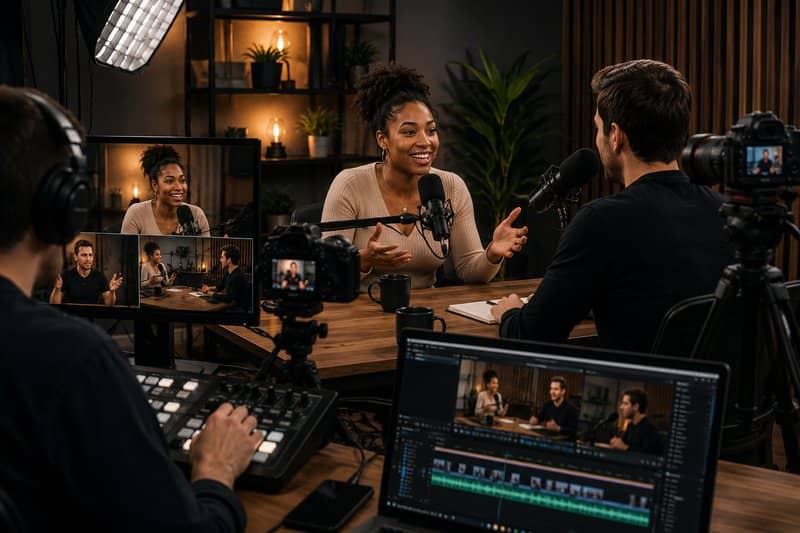
A premium production should include multiple camera angles, typically three or more, recording simultaneously. This allows the editor to switch between a wide shot, a close-up, and a reaction angle, creating a professionally produced video.
Multiple angles also give the finished video a more natural rhythm and variety. If your podcast is a conversation between multiple people, these angles can let viewers see the speaker, the listener, and their interaction.
All the different camera angles need to work together. They also need to be properly framed, lit, and synchronized so the editor can cut cleanly from one shot to another without creating distracting jumps or inconsistencies. All of this happens before you even start recording.
Professional Audio Engineering
A good microphone is only the starting point and shouldn’t be the only thing you rely on for your audio quality. Professional audio should include someone to monitor and adjust levels, reduce background noise, and make sure each speaker’s voice is clear and consistent.
Audio quality can make or break your content. Even when the picture looks great, muffled or distorted sound can distract people from what’s being said. A premium production should treat audio just as importantly as the visual side of recording.
Multiple people talking on a recording can add another layer of complexity. A host and a guest sharing a single microphone may result in uneven volume, especially when one person moves closer to or farther from the microphone. Each speaker should be mic’d separately so their levels can be adjusted independently.
Professional audio engineering is one of those things viewers may not consciously notice when it’s done well. They simply hear a conversation that sounds clear and natural.
Full Editing and Post-Production
No matter how good the lighting is or how many cameras are running, raw footage isn’t a finished episode. Someone still has to review the recording, synchronize the footage and audio, cut between camera angles, remove unnecessary pauses and mistakes, and assemble everything into a cohesive conversation.
Color and exposure may also need to be adjusted so footage from different cameras looks consistent. The final audio needs to be synced with the video, and any remaining technical issues addressed before the episode is ready for publication.
This can be one of the most time-consuming parts of the process. A single hour of recording with three cameras running produces multiple video files that must be reviewed and edited, along with audio tracks that need to remain synchronized.
That’s one of the biggest differences between a basic recording space and a full production service. A basic space may give you access to the equipment and the raw files. A full production service can deliver a finished episode ready to use.
Short-Form Content
A long-form conversation is only the beginning if you want to use your podcast across multiple platforms. The next step is to identify the strongest moments and turn them into shorter pieces of content.
A premium service can pull clips from the full episode and format them for platforms like Instagram Reels, YouTube Shorts, and other short-form channels. Each clip can be trimmed to focus on a single idea and formatted for the platform where it will be published.
This can turn a single recording session into a collection of content rather than a single episode. Instead of having to schedule another recording session every time you need something to post, you can draw from conversations you’ve already recorded.
Consider an insurance broker who spends 20 minutes explaining how a specific type of policy actually works. Within that conversation could be several moments that stand on their own: a common misconception corrected, a real cost comparison, or a straightforward answer to a question clients ask regularly. Each could become its own short clip without the broker having to record anything extra.
A Content Calendar and Posting Schedule
Content creation is only part of the process. Someone also has to decide when and where each piece should be published.
A content calendar can help organize the full episode and its shorter clips so everything doesn’t get posted at once. It also lets you track what has already been published, what’s scheduled next, and which pieces haven’t been used yet.
For a business owner, this can be one of the easiest parts of podcasting to overlook. You may have a finished episode and a folder full of clips, but if no one is responsible for publishing them, that content can sit unused.
From Recording to Finished Content
A video with excellent camera angles but poor audio can still feel unprofessional. Clean audio filled with awkward pauses may make an otherwise useful conversation difficult to watch. Great clips that never get posted don’t have an opportunity to reach an audience.
Each part of podcast production solves a different problem. The cameras create a professional visual experience. Audio engineering makes the conversation easy to hear. Editing can take the raw footage and turn it into a finished episode and clips. Those short-form clips give you more ways to distribute the conversation, and a posting schedule helps make sure your content reaches your audience.
The value of a full-service approach lies in how these pieces work together. Instead of managing all those moving parts on your own, you can focus on the conversation and the expertise you want to share.
At The Rookery Studios, these pieces are built into the production process rather than handled as separate services. We aim to make podcasting easier for business owners who don’t have the time or desire to manage every technical detail themselves.
For many professionals, this full-service podcasting approach has been the difference between having a podcast idea and actually maintaining one.