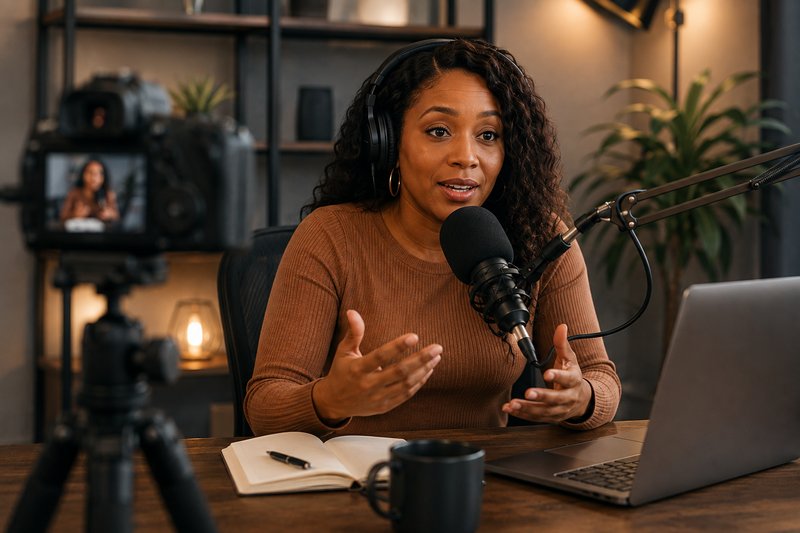
A business podcast might sound simple until you actually sit down to do it. You have to decide what to record, what equipment to use, how to edit it, where to publish it, and how to turn one recording into content for other platforms. Many business owners commit to starting a podcast only to discover how many moving parts are involved.
While all of these factors can feel overwhelming, you don’t have to figure everything out at once. Take things one step at a time and remember that you can always adjust as you go.
Choose a Format That Fits Your Business
Before you start a podcast, you need to decide what kind of show you want to produce. One option is a solo format, where you talk directly to the camera and answer the questions your customers ask every week. There is also an interview format, where you bring on guests.
A long-form episode gives you room to explain a topic or have a meaningful conversation without skimming past important details. Short-form clips, like pieces cut for Instagram Reels, YouTube Shorts, and similar formats, come later and are built from your initial recording.
Pick a schedule and stick to it. Audiences usually like to know when to expect the next episode, and a weekly show can build momentum. However, pick a schedule you can sustain before making a topic list. The most successful podcasts are usually the consistent ones.
Decide on Equipment
While a basic setup with one camera, a microphone, and some lighting is enough to get something recorded, it may not be enough to look and sound professional.
For example, a single camera angle can read as amateur, but getting multiple angles working together means each one should be properly lit. You also have to figure out how to keep all your cameras in sync during editing, and ensure you have enough processing power to handle multiple 4K video files at once. Once you add multiple cameras, lighting, microphones, storage, and editing software, the investment can quickly reach several thousand dollars.
Another option is to skip the equipment question altogether. You can rent time in a professional studio with the cameras, lighting, and audio setup already in place before you walk in. You can show up, record, and leave the technical side to someone else. Of course, this choice comes with its own financial commitment, but depending on how you want to run your podcast, it may be a wise decision.
Record Your First Episode
Multiple camera angles should be framed, lit, and synced before you hit record, and audio needs to be clean enough that background noise or an echoing room doesn’t undercut everything you just said.
When you aren’t distracted by technical problems, it can be much easier to focus on what you’re saying. A quiet room and a good camera angle can help your content and unique voice come through.
Edit for More Content
An hour of recording rarely turns into an hour of usable footage. You can pause, stumble over a word, or restart a sentence without worrying that those mistakes will make the final cut. Good editing can take care of it.
Multiple camera angles also need to be cut and stitched together at the right moments. Audio should be cleaned up and leveled so the final cut sounds like a single continuous conversation rather than three separate feeds.
This step is usually the one that people underestimate the most. It often takes two or more times as long to edit a single long-form episode as it does to record. This is before any short clips are made. However, it is also the step that is easiest to hand off entirely.
Once the long-form video is done, you can create more content by pulling shorter clips from the full conversation to post wherever else your audience spends time. That means finding the moments in a 30-minute conversation that stand on their own, cutting each down, adding captions, and formatting them for whichever platform they are headed to next.
Publish the Full Episode
Even though it’s a good idea to post your podcast on your business website, YouTube doubles as a search engine and keeps the full conversation available indefinitely. Some shows also distribute the audio version via podcast apps for people who prefer to listen while commuting or doing chores around the home.
Keep in mind that publishing isn’t the same as promoting. An episode sitting unlisted on a channel nobody checks does about as much good as an episode that was never recorded. The episode needs a thumbnail, a title, and a description that clearly conveys what someone will learn from watching it; otherwise, it may be hard for potential customers to find it. If you have any social media accounts linked to your business, you can also post your podcast there to reach even more potential listeners.
Develop a Consistent Posting Schedule
A batch of clips from one episode should go out on a schedule, not all at once or whenever there is spare time. A consistent posting schedule also makes it easier for your audience to know when to expect new content and may give you more opportunities to stay visible.
Keep track of what’s been posted, where it has been posted, and what’s still waiting in the queue. No matter how engaging your podcast is or how many clips you have ready to go, content distribution doesn’t happen on its own.
You Don’t Have to Do It All
It takes much more than just sitting down and having a conversation to start a business podcast. There is equipment to manage, episodes to record, footage to edit, clips to create, and content to publish consistently. The more often you publish, the more time those tasks can take.
That doesn’t mean you need to handle every part yourself. Some businesses keep the entire process in-house, while others use a done-for-you podcasting studio to handle everything past the conversation itself. The important thing is to build a podcasting process that fits your business, your budget, and the amount of time you can realistically commit.